ÖSSVCertified Instructor
14+Years Coaching
4 to 12Week Protocol
OnlineWorldwide Access
The invisible barrier to progress.
You have invested in the best equipment, spent countless days on the piste, and put serious effort into your fitness conditioning. Yet, when you hit steep terrain, turning to one side feels completely stable and locked in, while the opposite side chatters, skids, or consistently reacts a fraction of a second late. The problem is neither your skis nor your lack of effort.
The issue is a hidden reality: the left and right sides of your body do not possess the same capabilities or coordination, yet the sport of skiing demands identical, flawless execution from both legs hundreds of times per run.
Two Legs, Two Different Athletes
No human anatomy is perfectly symmetrical. Every one of us has a dominant leg, a more mobile hip on one side, and varying joint angles left and right. Skiing asks both legs to deliver the same movement hundreds of times a run, so that difference shows up as a weaker turn, an uneven stance, or a plateau you cannot train your way out of. This page explains how we compare your two sides and rebuild the training around the weaker one.
The critical detail that almost everyone misses is that this asymmetry is rarely linear. Often, one leg holds balance exceptionally well but generates less power, while the other is highly powerful but reacts sluggishly. One ankle might offer a greater usable range of motion, whereas the opposite side provides superior core control. Your ceiling on snow is not defined by your overall fitness; it is dictated by that one missing attribute on one specific side. This is precisely why lifting heavier squats in the gym usually solves nothing: you are merely reinforcing a muscle that is already strong, on the side that already dominates.
Where most skiers start
BalancePowerRangeControl
The ultimate goal of technique engineering
BalancePowerRangeControl
Left Side
Right Side
Nobody is built symmetrically and nobody needs to be. The goal is to lift the missing quality on the weaker side until the gap between your two legs stops costing you turns.
Signs that this is your problem
Every one of these you can check standing in your own living room. If one of them sounds familiar, read to the end.
Stance weight distribution
Deep-rooted habits.
When standing still off the snow, do you subconsciously shift your weight onto one specific leg? This seemingly minor habit is the foundation of the massive errors you experience on the slopes.
Asymmetrical dominance (Weak Side)
Confidence at the apex.
Are you entirely in command turning to the left, while turns to the right consistently result in skidding or a loss of balance? This is the clearest indicator of an imbalance in core strength or hip angulation.
One side doing more of the work
Load that never gets shared.
If one leg tires noticeably earlier than the other on a long day, that side is carrying more of the turn. We read that as a reason to compare your two sides properly, and nothing beyond that.
A harsh reality
Repetition cements your mistakes.
If any of that sounded familiar, running the same programme through both legs keeps the difference exactly where it is. Volume on its own tends to make a gap more comfortable rather than smaller.
How we bridge this biomechanical gap
- Elevate the missing link, not the entire limbIf one leg lacks range of motion and the other lacks balance, you are facing two completely different problems. A generalized training plan simply preserves this gap.
- Sometimes your dominant leg needs the correctionIf your stronger leg is powerful but unstable, adding weight training will worsen the situation. That side requires stability work, not heavier loads.
- The goal is harmony, not absolute symmetryNo human is perfectly symmetrical, nor do they need to be. The objective is for your neuromuscular system to deliver an identical, controlled turn on both sides under pressure.
- The nervous system dictates the paceNew movement patterns must be wired into the nervous system. This is why success here is measured in "weeks of consistent repetition" rather than exhausting workout sessions.
Two legs that behave differently do not move closer together by training them the same way. The work has to be aimed at the side that is behind.
Not ready for a full analysis yet? Start here.
The checklist is the short version of what we look at. Work through it on your own and you will already have a first idea of which side is carrying the turn, before you spend anything.
Get the Asymmetry Checklist
Ask on WhatsApp
What we compare between your two sides
Four qualities, always one side at a time. An average across both legs hides the single thing that is limiting you.
How each leg holds you up
One side at a time.
How steady each leg is on its own once the ground stops cooperating. This is where hesitation in a turn usually begins.
How each leg takes force
Pushing is the easy half.
Through the apex of a turn a leg spends most of its time absorbing rather than producing, and absorbing is usually where two sides come apart.
How far each side moves under control
Usable movement, not paper flexibility.
A side that cannot get where it needs to go under control will find a way around it, and that detour is what you feel as the weaker turn.
How quickly each side answers
Timing rather than strength.
On firm snow, catching your balance is decided in fractions of a second. Your two sides are rarely equally quick, and you feel that long before you can name it.
How the programme actually runs
Six steps, from your portal account to a side by side comparison you can read yourself.
1
You join the athlete portalYou get your own account in the Ski11 athlete portal. Your assessment sheet, your entries, your programme and your history all sit in one place, and they stay there between blocks.
2
You run the self-assessments at homeA structured set of self-assessments that you carry out on your own, in a small space, without a gym. Every one of them is done left side and right side separately, because that separation is the whole point.
3
You enter your own resultsYou put your results into the portal yourself. Since each side goes in on its own, the portal ends up holding two columns for you instead of one average that hides everything.
4
We read the difference, not the numberWhether your figures are high or low interests us far less than how far apart your two sides are. Small differences are normal and we leave them alone. We act on a gap large enough to be real rather than a bad evening.
5
Your programme is rebuilt around the weaker sideYou receive a 4 week block, a 12 week block or a full annual plan. The side that is behind gets the extra work. The dominant side gets what it actually needs, which is often stability rather than more load.
6
You repeat it and compareAt the end of the block you run the same assessments again and enter them again. You are comparing your own two sides against your own starting point, which is the only comparison that means anything here.
Equipment comes last. If a difference will not close through training, a boot sole adjustment (canting) can sometimes compensate for part of it. We can tell you whether that is worth pursuing. The measurement itself needs a laser alignment device and belongs to a professional bootfitter, so we point you to one rather than pretend we can do it from here.
Neuromuscular coordination and balance in action
Gallery and videos from past coaching sessions
Watch more videos on Instagram
Your Coach
Who writes the program and reviews your video analysis.
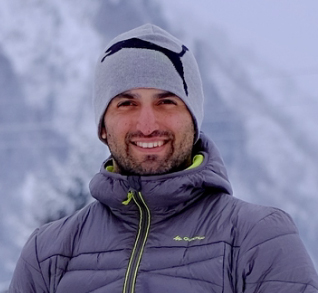
Arash Bakhshesh
Ski Trainer and Biomechanics Coach
English · Deutsch · Farsi
- National Level Experience and Ski Trainer: Former Assistant Coach for a National Alpine Team.
- ÖSSV Level 3 Ski Instructor: Certification from the Austrian Ski Federation.
- Focus: Precision kinematic video analysis and advanced functional conditioning.
Choose Your Training Block
Everything runs through the athlete portal, so you can start from wherever you happen to live.
The Reset
€149
4 week programme
- Athlete portal account
- Guided self-assessments, left and right separately
- A 4 week block built around your weaker side
- Written feedback on what your two columns show
Most Chosen
The Rebuild
€349
12 week programme
- Everything in The Reset
- A 12 week block in three progressive phases
- The plan is adjusted as your entries change
- Repeat assessments at the end, set against your start
The Annual Programme
By application
Custom, one full year
- A full year planned around your season and your travel
- Blocks rewritten whenever the gap between your sides moves
- Direct contact with your coach throughout
- An honest call on whether canting is worth measuring, plus a bootfitter referral
We are not a medical service. We do not diagnose or treat injuries or pain. If you have pain or a medical condition, see a qualified clinician first.
Cancellation and refunds
- Before the work startsCancel at any point before your programme is written and you get the full amount back. No reason needed.
- Once the programme has been startedFrom the moment we begin writing it there is no refund, because the work is already done and the finished block is yours either way.
- If what you send cannot be usedShould your entries or your footage not be usable, you hear about it before anything is written and you are refunded in full.
Transparency in our scope of practice
Our expertise lies in "movement analysis", not medical intervention. We do not diagnose injuries or treat chronic pain. Our focus is on identifying faulty movement patterns and providing biomechanical corrective training. If you are experiencing acute pain, your first priority is to consult a physician or physiotherapist; our coaching begins only after their clearance. (Services do not include lift tickets, gym equipment, travel expenses, or in-person workshop boot-fitting/canting labor).
Already know where you are weak and simply want a plan to follow? Then our
Dryland Training Blocks are the shorter route. If what you actually want is someone to read your skiing on video, that is
Remote Video Analysis, a separate service with its own packages. That page also carries the Free Technique Check: send one clip and you are told, in writing and at no charge, the single biggest thing holding your skiing back. Five places a week. On-snow work happens in
Private Ski Lessons, and for the reasons progress stalls, read
Why Skiers Plateau.
Ski11 Loyalty and Referral Program
Our returning athletes receive exclusive rewards and special privileges starting on their 6th day of coaching. Refer a new skier to us and earn credit toward your next training cycle.
Ready to uncover and correct the root of your technical errors?
Request access below. You get your portal account, you work through the assessments in your own time, and the programme is written from what you enter. If your two sides come out close enough that a corrective block would change very little, we will say so, and you will not be sold one.
Request Portal Access
Contact directly on WhatsApp
Frequently Asked Questions
Click on any question to view the answer.
What exactly do I have to do?
You get an account in the Ski11 athlete portal and a structured set of self-assessments that you run at home, on your own, in a small space and without a gym. Each one is carried out left side and right side separately, and you enter your own results in the portal. Your training programme is then written from the difference between those two columns, and at the end of the block you run the same set again to see what moved.
Can asymmetry actually be corrected, or must I just cope with it?
In most of the cases I see, the difference sits in movement rather than in structure, and movement responds to training: awareness of what you are doing, functional work off the snow, and targeted drills on it. Some differences are structural and training alone will not close them. Where that is the case, a boot sole adjustment can sometimes compensate for part of the difference, and that is a decision taken in person, with your boots in front of us.
Is some physical asymmetry not entirely normal?
It is completely normal, and that is exactly where our work begins. The core issue is not the existence of this difference; it is the lack of awareness regarding which specific movement deficit is hiding on which side of your body. This blind spot causes skiers to train incorrectly, reinforcing their primary errors for years.
Can I not simply train my weaker leg more?
Occasionally this approach works, but in most cases, it does not. If your weak turn originates from a leg that is strong but unstable, increasing strength training will only exacerbate the issue. In biomechanical correction, the sequence and type of training are far more critical than the volume.
Do I need a gym membership or specialized equipment?
No. Our assessments and movement drills are designed to be executed in small spaces without the need for complex machines. If you do have access to a gym, we will incorporate its facilities, but the success of our program never relies on gym equipment.
Is this considered a medical evaluation?
No, and understanding this distinction is vital. We assess "movement capacity and patterns", not tissue health. If a weakness on one side of your body is due to an untreated injury, a physiotherapist must complete the healing process first. We will only begin neuromuscular reconstruction after their medical clearance.
How long will it take before I feel the impact on the snow?
Your mental awareness changes almost instantly; once you understand the root of the weakness, you will notice how your legs behave differently on every run. However, for the newly engineered movement pattern to become ingrained in your nervous system and hold up under high speeds, it typically requires four to six weeks of consistent, disciplined practice.
I only ski a few days a year. Is this analysis justified for me?
More so than for anyone else! When your days on snow are limited, you cannot afford to waste that precious time reinforcing incorrect patterns. Furthermore,
the majority of our corrective training is done off the snow. That means you are investing time throughout the year
so you can experience peak performance during those few days on the mountain.
Do your services include working with ski teams and clubs?
Yes. With a squad, the same side by side profile is built for every athlete on the roster. What usually comes out is a pattern the coaching staff had already sensed on the snow but had never had laid out in front of them, one athlete at a time.